AI engineering is no longer an experimental discipline reserved for research labs. It has become a core engineering function responsible for building, deploying, and maintaining AI-powered systems in real-world applications.
This guide explains AI engineering fundamentals in a practical, system-oriented way—focusing on how AI solutions are designed, built, and operated in modern software environments.
Table of Contents
What Is AI Engineering?
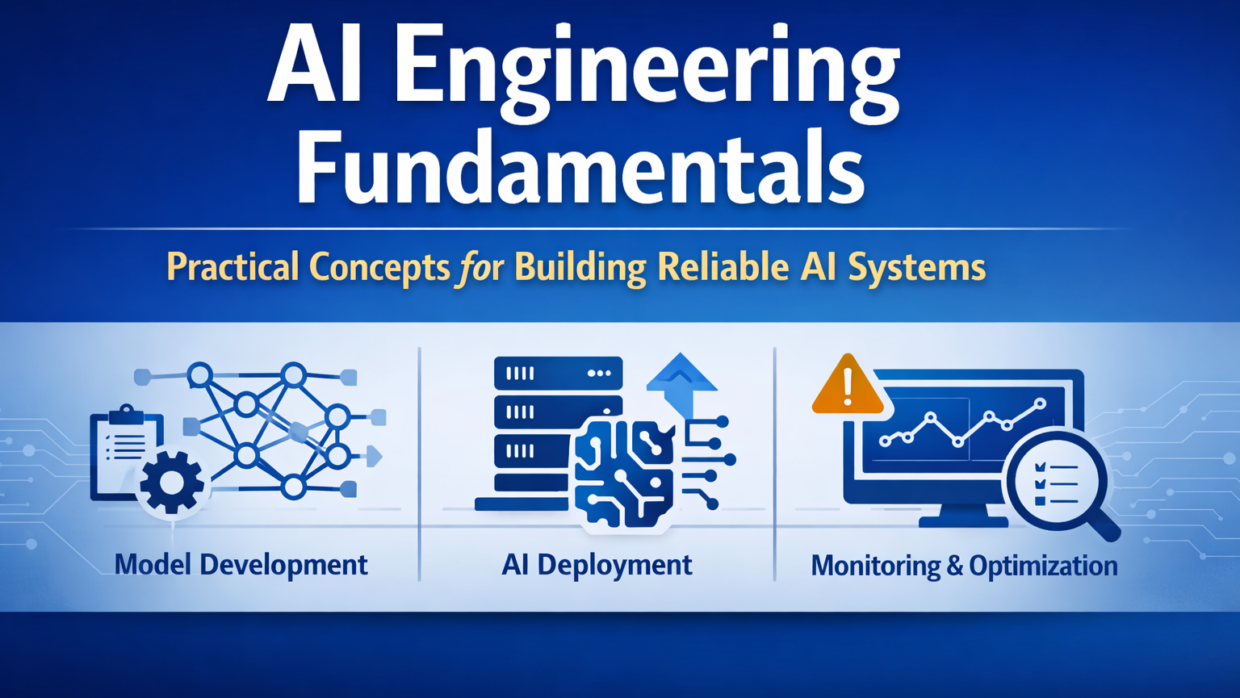
AI engineering is the practice of designing, building, deploying, and operating AI systems reliably in production. It combines software engineering principles with machine learning, data systems, and infrastructure to ensure AI models work consistently at scale. 
Unlike traditional machine learning research, AI engineering focuses on:
- Production readiness
- System reliability
- Performance and cost control
- Monitoring and maintenance
AI engineering treats AI models as part of a larger system, not standalone artifacts.
Why AI Engineering Fundamentals Matters
As AI adoption increases, many organizations discover that building a model is only a small part of the problem. The real challenges appear after deployment.
AI engineering exists to solve problems such as:
- Models failing in real-world conditions
- Performance degrading over time
- Unexpected costs from inference workloads
- Lack of observability and control
Without proper engineering practices, AI systems become fragile, expensive, and difficult to trust.
AI Engineering vs Machine Learning vs Data Science
These roles are often confused but serve different purposes.
Data Science
- Focuses on exploration and insights
- Works with datasets and statistical analysis
- Often experimental and offline
Machine Learning
- Focuses on training and optimizing models
- Improves accuracy and performance
- Produces models, not systems
AI Engineering
- Focuses on end-to-end systems
- Handles deployment, scaling, and monitoring
- Ensures AI works reliably in production
AI engineering bridges the gap between models and real-world applications.
Core Components of AI Engineering Fundamentals
AI engineering systems are built from several foundational components.
1. Data Pipelines
Data is the foundation of any AI system.
AI engineers design pipelines that:
- Collect data from multiple sources
- Validate and clean incoming data
- Handle schema changes and missing values
- Ensure consistent data for training and inference
Poor data pipelines lead to unreliable models, regardless of how good the algorithms are.
2. Model Development and Selection
AI engineering does not focus on inventing new algorithms. Instead, it focuses on:
- Selecting appropriate model types
- Evaluating trade-offs between accuracy, latency, and cost
- Managing model versions
The goal is not the most complex model—but the most suitable model for the system.
3. Training and Evaluation Workflows
Training workflows must be:
- Repeatable
- Version-controlled
- Auditable
AI engineers ensure:
- Training data is tracked
- Model versions are reproducible
- Evaluation metrics reflect real-world behavior
This prevents “works on my laptop” problems.
4. Deployment and Inference Systems
Deploying AI models introduces new challenges:
- Latency constraints
- Scalability requirements
- Hardware dependencies (CPU, GPU)
AI engineering focuses on:
- Batch vs real-time inference
- Autoscaling strategies
- Rollbacks and safe updates
Deployment is where most AI projects succeed—or fail.
5. Monitoring and Observability
Once deployed, AI systems must be monitored continuously.
Key monitoring areas include:
- Model performance over time
- Data drift and distribution changes
- Prediction confidence and errors
- System latency and cost
AI engineering treats models as living components that evolve with data and usage.
AI Engineering Lifecycle (End-to-End)
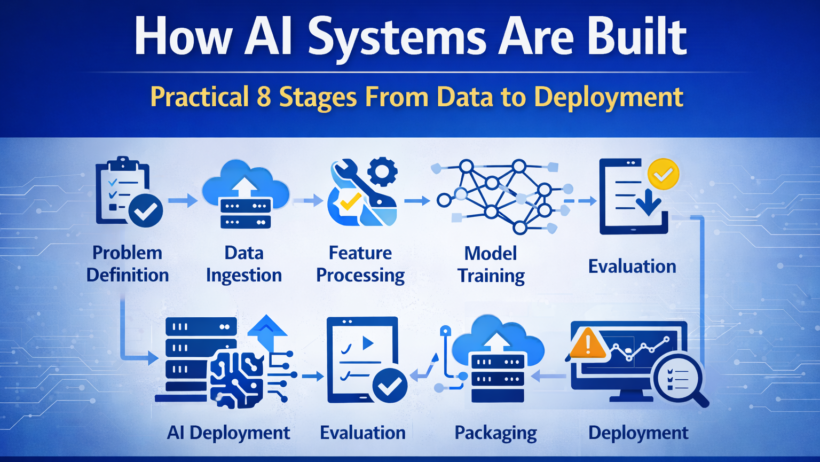
A typical AI engineering lifecycle looks like this:
- Problem definition
- Data collection and validation
- Model selection and training
- Evaluation and testing
- Deployment to production
- Monitoring and iteration
This lifecycle repeats continuously as data and requirements change.
Common Challenges in AI Engineering Fundamentals
AI engineering introduces challenges that traditional software teams may not expect.
Model Drift
Models degrade as real-world data changes.
Hidden Feedback Loops
AI systems can influence the data they later consume.
Cost Management
Inference costs can grow rapidly at scale.
Debugging Complexity
Failures may originate from data, models, or infrastructure.
AI engineering exists to anticipate and manage these risks.
AI Engineering and Infrastructure
AI systems rely heavily on infrastructure decisions.
Key considerations include:
- Compute type (CPU vs GPU)
- Storage for datasets and artifacts
- Model hosting strategies
- Networking and latency
Infrastructure choices directly affect performance, reliability, and cost.
AI Engineering and DevOps
AI engineering borrows heavily from DevOps but introduces additional complexity.
Shared principles:
- Automation
- Continuous integration
- Monitoring
AI-specific challenges:
- Model versioning
- Data dependencies
- Non-deterministic behavior
This is why AI engineering is often considered an evolution—not a replacement—of DevOps.
Responsible and Trustworthy AI Systems
Modern AI systems must be:
- Transparent
- Fair
- Secure
- Auditable
AI engineering includes safeguards for:
- Bias detection
- Privacy protection
- Responsible deployment
Trust is not optional—it is a system requirement.
Who Should Learn AI Engineering Fundamentals?
AI engineering is relevant for:
- Software engineers working with AI features
- DevOps engineers supporting ML workloads
- Data scientists moving toward production systems
- Technical leaders overseeing AI initiatives
You do not need to be a researcher to be an AI engineer.
How This Guide Fits into the ContForge AI Series
This article is the foundation pillar for the ContForge AI knowledge series.
Upcoming guides will explore:
- How AI systems are built
- AI models and LLMs
- Prompt engineering
- AI infrastructure and deployment
- Reliability, security, and responsible AI
Each guide will link back to this page to build a complete AI Engineering Fundamentals knowledge graph.
Conclusion
AI engineering transforms AI from experimental models into reliable, scalable systems. It brings discipline, structure, and engineering rigor to AI-powered applications.
Understanding AI engineering fundamentals is essential for building systems that are not only intelligent—but also dependable and trustworthy.
This guide provides the conceptual foundation. The next step is learning how these principles are applied in real systems, which the following ContForge articles will cover in depth.
Frequently Asked Questions
What is AI engineering?
AI engineering is the practice of building, deploying, and maintaining AI systems in production using engineering principles.
Is AI engineering the same as MLOps?
No. MLOps focuses on ML workflows, while AI engineering covers the entire system, including infrastructure, deployment, and monitoring.
Do I need deep math skills for AI engineering?
Not necessarily. AI engineering emphasizes systems, reliability, and operations more than mathematical theory.
Is AI engineering used in production?
Yes. AI engineering practices are essential for deploying AI reliably in real-world applications.
💬 Community Question
Which part of AI engineering do you find most challenging: data, models, deployment, or monitoring?